
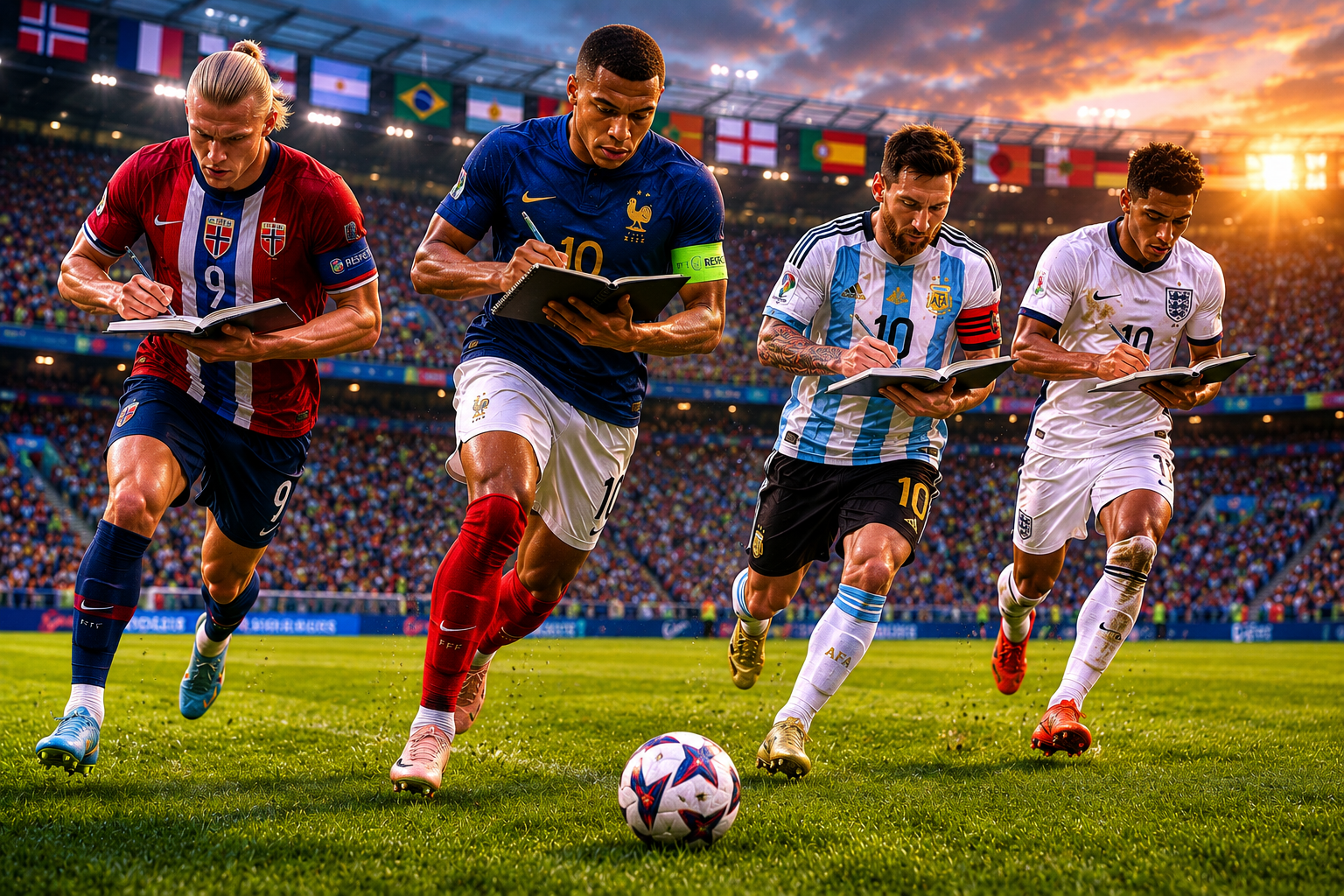
Not every gifted child cares about football. Some will ignore the World Cup entirely and continue with dinosaurs, coding, mythology, chemistry, trains, languages, or whatever currently occupies their attention. But for others, something curious happens.
A tournament begins, and suddenly football is everywhere at home. Not necessarily in the usual sense of supporting a team or collecting stickers, although that can happen too. Instead, the interest starts spreading sideways.
The child wants to know why one group looks “harder” than another. They ask how FIFA rankings work, why Belgium used to be ranked so highly, or whether penalty shootouts are actually random. A match becomes an excuse to discuss probability. National anthems trigger questions about languages and history. One player leads to an interest in migration, training academies, or sports psychology.
Parents of gifted children often recognise the pattern: what looks like a passing interest turns into a surprisingly deep investigation.
There is almost no research specifically on gifted children and football tournaments, so it would be unwise to make sweeping claims. Still, several findings from gifted education and developmental psychology help explain why a global event like the World Cup can become unusually absorbing for some children.
The Brackets Are Often as Interesting as the Matches
Many parents notice that gifted children are not always interested in sport in the same way as their peers. Some care less about loyalty to a team and more about understanding how the whole system works.
For certain children, the tournament’s bracket itself becomes fascinating. This should not surprise us too much. Research on gifted development has long observed that many intellectually advanced children are drawn to complexity and abstract relationships. In their discussion of gifted cognition, Dai and Chen (2013) note that gifted learners often seek intellectually demanding material and may tolerate complexity more comfortably than age peers. Similarly, Subotnik, Olszewski-Kubilius and Worrell (2011) describe how advanced learners frequently engage deeply with domains that reward sustained analysis.
A World Cup tournament is full of moving pieces. Rankings matter, but not perfectly. Statistics matter, but upsets happen. The rules are structured enough to make prediction possible, while remaining uncertain enough to stay interesting. For a child who likes to explore complex systems, this can be irresistible.
Some children end up making spreadsheets. Others draw alternative brackets by hand. Some develop elaborate theories about “easy” and “hard” sides of the tournament and will happily explain them over dinner whether anyone asked or not.
The Rabbit Hole Often Gets Wider
One of the pleasures of parenting gifted children is seeing how unexpectedly their interests connect. Football rarely stays only about football.
A child starts by supporting Argentina and suddenly wants to understand why some players have italian surnames. That leads to migration, colonial history, or dual nationality rules. The arborescent thought, this tendency to branch outward is something many parents already know well. Gifted children often build unusually dense networks of associations between topics.
Research on giftedness frequently notes this pattern of broad and deep curiosity. In her work on highly gifted development, Gross (2004) describes how some children move rapidly between fields while still pursuing substantial depth.
The World Cup happens to be unusually good at feeding this kind of curiosity because it mixes geography, language, statistics, music, politics, identity, and storytelling all at once.
Parents sometimes worry that a child has become “obsessed” with football when, in reality, football is simply acting as the organising theme for a much broader intellectual exploration.
Players Become More Than Celebrities
Gifted children are often interested in people in analytical ways.
Rather than simply admiring a famous player, they may want to understand how the person became successful, or why are some teams full of talented individuals but fail collectively. Children who ask these kinds of questions are often thinking about systems, training, psychology, and human behaviour without necessarily having the vocabulary for it yet.
Research on intrinsic motivation helps explain why these interests can become unexpectedly intense. Longitudinal work by Gottfried and colleagues (2005) found that gifted learners frequently show strong self-directed engagement in areas they find personally meaningful.
Parents know what this looks like in practice. A child casually mentions wanting to know more about one player and, two days later, somehow knows the entire youth career history of the French squad.
Statistics Suddenly Become Fun
One quiet advantage of tournaments is that mathematics sometimes stops feeling abstract. Probability matters because qualification depends on it. Numbers matter because goal difference changes outcomes. Statistics suddenly become attached to something emotionally meaningful, especially since football has been getting more and more similar to American sports in terms of data analytics for statistics and for collateral games such as Fantasy Football.
Expected goals, possession percentages, passing accuracy, historical records, penalty probabilities: all these can become enjoyable because they answer real questions the child genuinely cares about.
Educational research on expertise and sustained learning suggests that interest matters enormously. People tolerate complexity far more easily when motivation comes from genuine curiosity. The classic work by Ericsson, Krampe and Tesch-Römer (1993) on expertise development emphasises how sustained engagement in meaningful domains shapes learning over time.
That does not mean parents should turn the World Cup into homework. Usually the better approach is simply to notice where the curiosity already exists.
Sometimes the Feelings Are Bigger Than Expected
If you parent a gifted child, you may already know this part: the emotional investment can be surprisingly intense.
A child who spent days analysing outcomes may feel genuinely devastated when a team loses unexpectedly. A refereeing decision may produce outrage. Penalty shootouts can feel unbearable.
This is not unique to gifted children, of course, but research on gifted development has often discussed asynchronous development and emotional intensity. It is important to remember that it often happens that gifted children understand things intellectually before they can regulate the feelings that come with them.
The literature is mixed and caution is warranted, but reviews such as Neihart (1999) suggest that emotional intensity and perfectionistic tendencies can appear in some gifted populations. Similarly, discussions of asynchronous development, including work by Silverman, highlight how advanced cognition does not always develop in step with emotional regulation.
Sometimes children know perfectly well that uncertainty is part of sport and still feel crushed when reality refuses to cooperate with their predictions. That is not necessarily a problem. Disappointment, uncertainty, and unpredictability are also part of what sport teaches.
A Few Ways Parents Can Make the Tournament Even More Enjoyable
There is no ideal way for gifted children to experience the World Cup, because gifted children are not all alike. Still, a few things often seem to help.
Following the child’s curiosity tends to work better than steering it too aggressively. If the interest shifts from football to flags, statistics, migration, or anthems, that is probably fine.
Watching together can also matter more than people realise. Some children enjoy having someone willing to entertain oddly specific conversations about tactical formations or improbable qualification scenarios.
And occasionally it helps to remember that intense interests often burn brightly for a while and then evolve into something else.
The child who memorises every squad this summer may be studying ancient history or probability theory next year. Or they may still be talking about football.
Keep updated when a new post is out!
Leave a Reply